FREE TOOL LAUNCHED! CALCULATE RENEWAL FEES FOR YOUR PATENT FAMILY INSTANTLY
Try now
A grace period is an extra window after a missed patent renewal deadline during which the fee can still be paid, almost always with a surcharge. It typically lasts up to six months, though the length and the rules vary by country, and not every jurisdiction offers one.
More than the original fee, sometimes considerably more. Offices take one of two approaches: a fixed surcharge regardless of when you pay, or an escalating one that grows the longer the payment is late.
The surcharge is separate from the patent renewal fee itself, so a late payment means paying both.
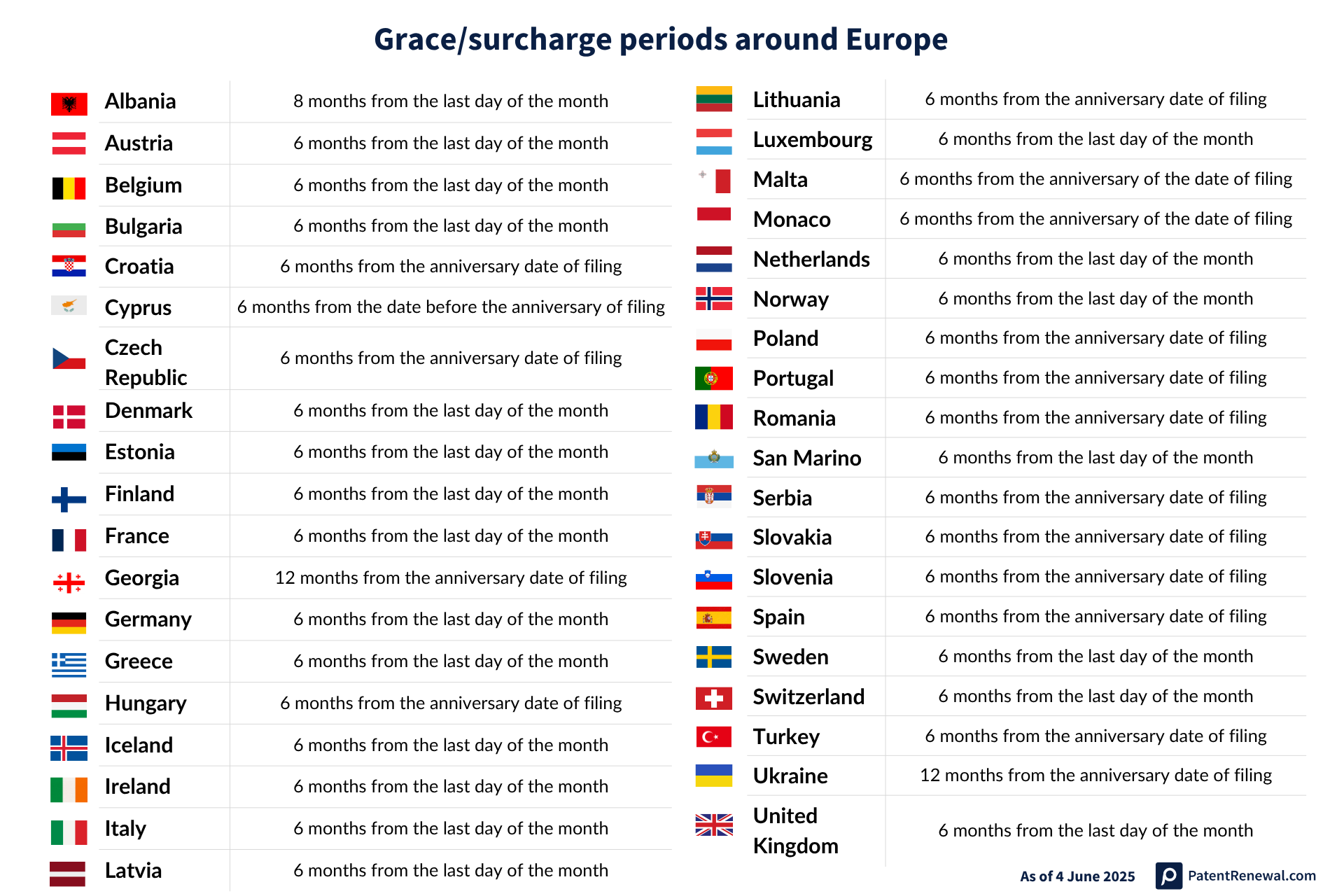
Six months is the most common length, but the range is wide.
| Length | Examples |
|---|---|
| Up to 12 months | Georgia, Ukraine |
| 8 months | Albania |
| Up to 6 months | Most jurisdictions |
| None | Some jurisdictions offer no grace period at all |
Where no grace period exists, a missed deadline ends the patent immediately, with restoration the only remaining option.
We have mapped the grace and surcharge periods across Europe:
In many jurisdictions, yes. The patent renewal fee is outstanding rather than the patent being dead, and paying it with the surcharge returns the patent to good standing.
The treatment differs between offices, so the register for that jurisdiction is the reliable answer rather than a general rule.
The patent lapses. Some offices allow restoration or reinstatement afterwards, but it is discretionary, time limited, and usually requires showing the failure to pay was unintentional. See what is an expired patent for how that works.
Relying on a grace period is expensive by design.

