

Talk IP to me: AI for IP to work faster, smarter & safer
- The IP profession is facing a talent shortage due to an aging workforce.
- AI helps improve quality and efficiency but cannot replace human judgment.
- People plus AI deliver significantly better outcomes than either alone.
- Prompt engineering is becoming a core IP professional skill.
- Strong leadership and governance determine successful AI adoption.
- AI will help preserve institutional knowledge in IP in the future.
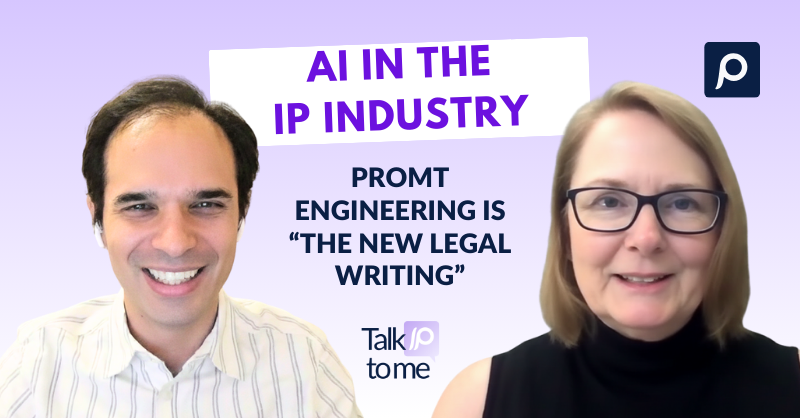
In this episode of Talk IP to me, our host David Breitenbach talks with Sharon Shofner-Meyer, a seasoned executive and strategist with deep expertise in legal tech, intellectual property and AI product management - also the author of IP work reinvented.
They discuss why the IP profession is facing a capacity crisis, how AI can support quality work without replacing human expertise, and what leaders must do to guide their teams through this transformation.
Meet our guest: Sharon Shofner-Meyer
Before moving into IP, Sharon built her career in genetics and cell biology. Working alongside patent attorneys on research projects introduced her to the field and quickly caught her interest.
“I love the idea that you could stay connected to innovation without bench work.”
What really stuck with her was the chance to stay close to cutting-edge innovation, just without being in the lab every day. That combination clicked.
Later on, Sharon joined Thomson Reuters, where she spent many years working in product development. This was long before today’s generative AI boom, but she was already seeing early versions of AI in action. Watching that evolution over time shaped how she thinks about technology and its role in patent work today. She explains that AI has been part of IP for decades, but the recent breakthroughs with transformer models have pushed things into a whole new phase.
“It’s not dead yet, but we need to adjust to really make it sing.”
At the same time, she describes the current IP ecosystem as fragile. In her book IP Work Reinvented, Sharon outlines how patent professionals can navigate this shift, blending human judgment with AI tools to improve quality and efficiency. She shows why new skills like prompt engineering and adaptive leadership are becoming essential as the profession evolves.
Why the IP profession is facing a talent shortage
One of the biggest issues Sharon points out is the shrinking talent pool in IP. Many patent professionals are getting older, while fewer young people are entering the field.
“We’re down to numbers we haven’t seen since the nineties.”
Getting into IP takes time. You need strong technical knowledge, legal training, and years of experience. That makes it a tough career path to enter. As senior professionals retire, there simply are not enough new people ready to replace them.
At the same time, patent filings keep climbing. Offices like the EPO and USPTO are seeing record numbers. So demand is going up, but the number of people who can actually do the work is not. That gap puts real pressure on the system.
She also highlights how much more specialized technology has become. Fields like AI, green tech, and advanced healthcare need deep, niche expertise.
“Green tech is another area that is growing, and of course healthcare is always there. Then you have all the nuances of sub-technologies, like mRNA and CRISPR. You can’t just be a general biologist and be able to write patents effectively in that environment. So those areas, green tech, healthcare, especially pharma, and AI, all require very specific expertise.”
How AI improves patent quality without replacing people
Sharon is very clear on one thing. AI should support people, not replace them. She sees it as a quality booster.
“If you draft a patent in 20 hours, AI can help cut that by 40%. So instead of 20 hours, you are looking at closer to 12. And that is significant. Now you can take on more work. A lot of that time saving comes from the iteration, the checking, and the validation process.”
But she strongly warns against letting AI handle the first draft.
“I would not recommend using AI for the initial draft. It stifles thinking.”
Her approach is simple. Write first, then use AI to check your work. Look for missing points, unclear language, or things that do not quite add up.
Her team even tested this in a large study. They compared work done by humans alone, AI alone, and humans working with AI.
“The people plus AI combo was 40% less likely to have errors. We did not even measure time, we only looked at quality, and the difference was significant.”
For Sharon, this proves the point. The real magic happens when humans and AI work together.
Why prompt engineering is becoming a core IP skill
One of Sharon’s boldest statements is that prompt engineering is becoming just as important as legal writing.
“Prompt engineering is the new legal writing. I actually think it is one of the most important things law schools should be teaching. Not just theory, but real practice. Because it is never one prompt. You prompt, you see what you get, and then you iterate.”
In her own practice sessions, she puts this into action. Participants had to draft using only AI and refine their prompts over and over again, learning through iteration what actually works.
For Sharon, prompt engineering means giving the model clear context, constraints, and a specific task, then adjusting until the output is usable. In patent work, that discipline helps keep the AI focused and makes the results more reliable.
How governance shapes AI adoption in IP teams
During the discussion she explained that she understands why some firms still ban AI, especially because of confidentiality concerns. But she also points out that AI has been quietly built into tools we use every day for years. She believes this fear will fade with time.
“I think the best thing is always to be incredibly transparent about what your process is, what your strategy is, and what tools you're using. So there's no question later, if they ever were to find out.”
She does warn about weak governance, though. Some firms say “no AI” without realizing their own tools already rely on it. That can push employees to use outside tools in secret.
What AI-literate leadership really means
Sharon makes it clear that adopting AI is not just a tech decision. It is a leadership challenge. Tools alone do not change anything. Real change happens when leaders stay involved and guide their teams through the transition.
"When I say lead, I really mean lead all the way through. It is about developing the right roles, deciding whether to train internally or hire externally, and making sure the whole team is with you. Not kicking and screaming, but genuinely excited about where you are taking the department or the firm. Sometimes you have to slow down first, step off the track, learn the tools, and then you come back faster than before."
For Sharon, this short-term slowdown is the price of long-term speed. Teams may pause to learn new systems, but once they are back on track, they work faster and with more confidence.
How Sharon sees the future of IP work
Looking ahead, Sharon predicts AI will evolve faster than any technology the IP industry has seen. Voice-based systems and virtual AI teammates will become common.
“And it's going to become more interactive, just because folks think differently and a lot of people think, by talking out loud. We’ll have firm-trained AI partners holding institutional knowledge.”
These tools will not replace professionals but preserve expertise and support better decision-making.
For young patent attorneys, her advice is to:
- Build a strong peer network.
- Find mentors early.
- Take every relevant AI and process-improvement course available.
“Lift and shift everything you can. The tool is the smallest part of success.”
Sharon’s main takeaway is not really about the tech itself, it is about how people approach it. AI is not a magic fix, it takes the right mindset, good leadership, and a willingness to keep learning if you want it to work well.
For the full conversation with Sharon, listen on Spotify, Apple Podcast, or YouTube. Follow Talk IP to me for more real stories and practical insights from the IP industry.
.png)
