IP renewal is a recurring operational task that requires discipline and specialized expertise
An IP renewal service provider focuses only on maintaining rights and building structured processes around renewals.
Clear separation between legal strategy and IP renewal management improves accountability and visibility.
Dedicated IP renewal service providers bring renewal specific expertise across jurisdictions and reduce internal administrative load.
Modern IP renewal software gives you centralized tracking, defined approval workflows, and real time status visibility.
Transparent pricing, structured onboarding, and validated data migration are essential when choosing a provider.
IP renewal requires accuracy, strict deadline control, and financial transparency. Many organizations treat IP renewal payments as routine administration, but the structure behind those payments directly affects cost, risk exposure, and budget planning.
This guide explains what IP renewal service providers do, how renewals are typically handled today, what benefits specialized providers bring, how IP renewal software supports execution, and what to look for when choosing the right provider.
What is an IP renewal service provider?
In the global IP ecosystem, different service providers focus on different parts of the IP lifecycle. Some specialize in filing and prosecuting applications. Others focus on litigation or strategic advisory work. IP renewal service providers handle one specific part of that lifecycle: the ongoing maintenance of granted IP rights (patents, trademarks, designs and utility models).
In short, they take care of the administrative and financial side of keeping IP rights valid worldwide. They handle renewal and local payment requirements, execute payments on time, and confirm compliance. Providers typically send proactive IP renewal notices, estimated fees, they provide proof of payment post-renewal, data validation checks to catch errors, and comprehensive reporting tools for portfolio oversight.
Renewal execution is different from prosecution or legal strategy. The rules are already defined. Deadlines are set by each patent office, the fee schedules are public, and the payment steps are structured. Their responsibility is to make sure everything is tracked correctly and paid on time.
Specialized IP renewal providers build their systems around that precision. If done right IP renewal should become a controlled operational function rather than a reactive administrative task.
How IP law firms handle IP renewals
Many companies entrust IP renewals to their IP law firms or patent attorneys because those firms already handle the drafting, prosecution, filing, national validation, enforcement, advisory work, and other legal matters. It feels natural to keep everything under one relationship. However, in most cases law firms typically handle renewals in one of two ways. Either they outsource the execution to a third-party IP renewal provider, or they manage the renewal process internally:
When renewals are outsourced, the law firm remains the primary contact, while an external IP renewal service provider manages IP maintenance (often without their clients being aware of it). In this structure, the outsourced IP renewal service provider charges for execution, and the law firm adds their handling fee on top. As a result, clients can end up paying two service margins for the same IP renewal transaction.
When IP renewals are handled internally, the process is often manual or based on general administrative systems rather than specialized IP renewal platforms. Because IP renewals are not the core operational focus of a law firm, the same level of automation and scale efficiency that dedicated IP renewal service providers use is typically not available. Each renewal requires manual internal review, coordination, invoice handling, and payment execution, which consumes billable time. This additional handling effort leads to higher service costs compared to automated, renewal-focused execution models.
Moving IP renewal execution to a provider does not mean replacing your IP law firm. You can continue working with your attorneys for drafting, prosecution, enforcement, and strategic portfolio decisions. The IP renewal service provider can simply take over the statutory payment process and structured monitoring, all this by reducing costs for you. And as we’ll cover in the next sections, this change brings several additional benefits beyond just handling the payments.
What are the benefits of using an IP renewal provider?
Separating strategic legal advice from IP renewal execution allows each function to operate at its highest value. Choosing a specialized IP renewal provider supported by robust IP renewal software, improves cost control, operational efficiency, portfolio visibility, and risk management. They affect how your IP renewal process functions. It brings benefits as:
Specialized IP renewal expertise: IP renewal service providers focus exclusively on IP maintenance across jurisdictions. Their IP teams work daily with annuity rules, surcharge periods, reinstatement procedures, and jurisdiction-specific renewal requirements.
Direct execution without layered intermediaries: Working directly with a specialized IP renewal provider removes unnecessary intermediaries from the renewal chain. When renewals pass through multiple parties, service margins can accumulate. A direct execution model reduces duplicated fees and keeps responsibility clearly defined.
Reduced internal administrative burden: IP renewal coordination no longer requires internal tracking, invoice forwarding, deadline chasing, or manual reconciliation. IP and finance teams regain time for higher-value work.
Portfolio-wide coordination across jurisdictions: A specialized IP renewal provider manages renewals across different countries through one centralized operational model. While local legal requirements always differ, reporting formats, approval workflows, deadline monitoring, and billing structures remain consistent across your entire portfolio, making it more predictable and easier to control.
What to consider when choosing an IP renewal software
Once you decide to work with a specialized IP renewal provider, the next question is how renewals are actually managed day to day. What matters is not just having software, but how that system is built and how it supports your internal processes. Since this is what you and your team will actually use to track renewals, review costs, and manage decisions day to day.
Every company and team works differently. The number of renewals you manage, your internal approval process, and your reporting needs all influence what kind of system will work best for you. Software quality and capabilities can vary widely between providers, and this directly affects how easy your IP renewal process will be.
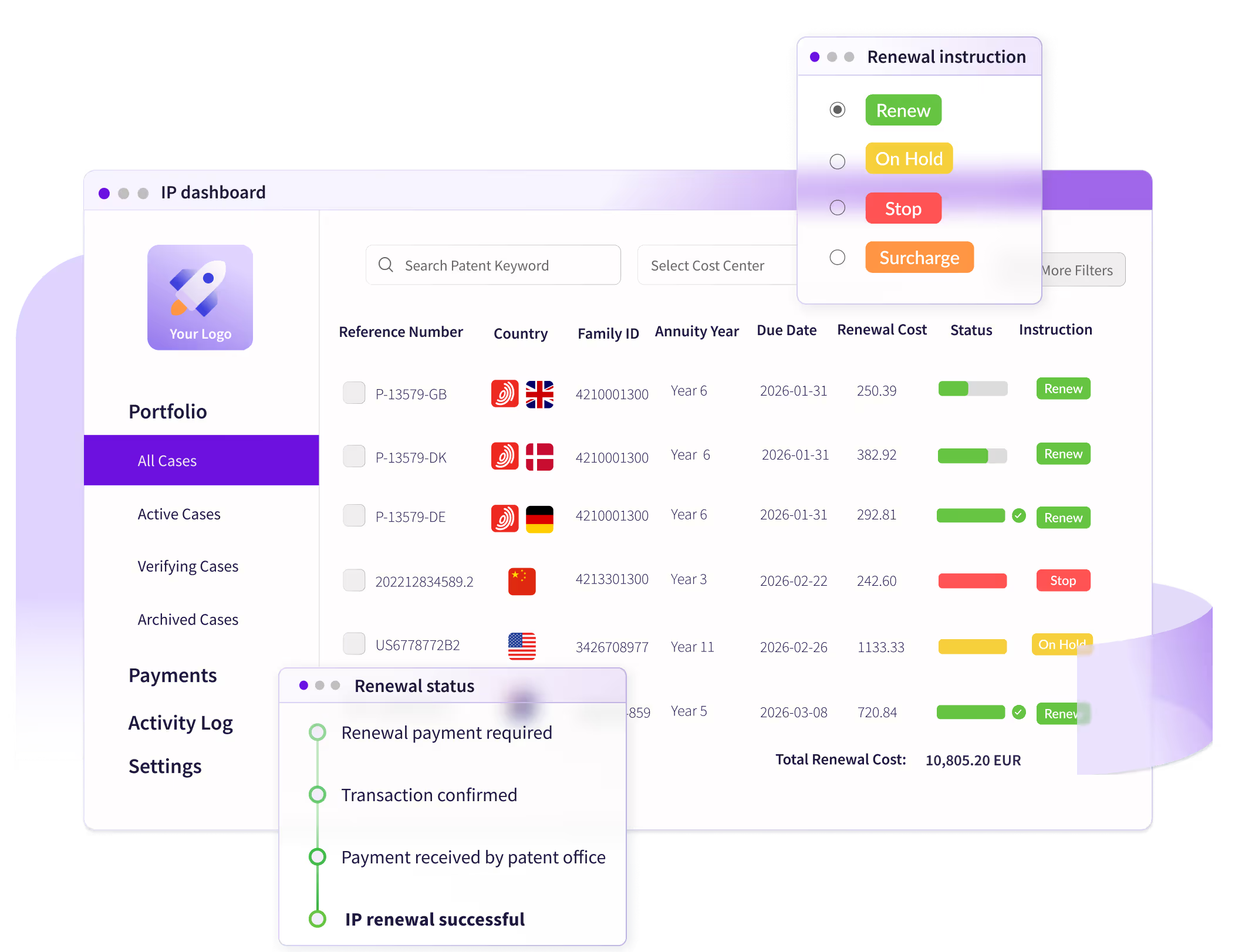
Flexible IP renewal instructions: You can put your rights on auto-renew, place specific rights on hold, stop renewals, or allow surcharge status when needed. This provides controlled decision flexibility without interrupting compliance.
Automated deadline monitoring across jurisdictions: The system tracks renewal due dates centrally and sends structured alerts before deadlines approach. This reduces reliance on manual tracking through spreadsheets or email reminders.
Step-by-step renewal status tracking: Each renewal can be followed from instruction to payment confirmation and patent office acknowledgment. This improves visibility into what has been executed and what is still pending.
Centralized portfolio & document management: Each IP right includes a dedicated summary tab where all relevant information is stored in one place, including IP renewal history, patent office links, costs, invoices, power of attorneys, and confirmations. This transparency removes the need to search across separate systems or communication threads.
Transparent pricing and export-ready invoicing: Invoices separate official fees and all non-official fees like service fees, currency exchange rates, transaction costs, local agent fees (if any). Export-ready formats or ERP integration options reduce manual reconciliation work.
Advanced filtering and search tools: Rights can be filtered by jurisdiction, IP type, annuity year, cost center, renewal status, internal references and many more. This makes large portfolios manageable without manual sorting.
Automated data verification with expert review: The software checks for inconsistencies in renewal dates, annuity years, and jurisdiction-specific rules. In addition, IP specialists review portfolio data to confirm accuracy before execution.
Budget forecasting and renewal cost planning: Generate IP renewal cost forecasts for your entire IP portfolio or selected IP rights. Plan IP budgets in advance, understand upcoming financial commitments, and projections for internal planning.
Role-based access and activity logs: Users can be assigned defined roles with specific permissions. A detailed activity log records who approved or updated information, supporting accountability.
Scalable global coverage: The system supports IP renewals across multiple jurisdictions within one structured framework. This allows portfolios to grow without changing the operational model.
Secure data infrastructure: Controlled access environments, encrypted storage, and compliance-oriented hosting standards protect sensitive IP portfolio data.
Managed onboarding and portfolio migration: Portfolio data is migrated, validated, and configured during onboarding. This reduces transition risk and ensures the IP renewal process continues without disruption
How to evaluate an IP renewal provider
Choosing the right IP renewal provider requires more than comparing service fees. You need to understand how their structure, systems, and accountability model work in practice. Use the following points as a practical evaluation guide:
Start with transparency. You should have full visibility into IP renewal status, history, approvals, all cost categories and execution so you always know exactly what has happened and what is coming next.
Look beyond the service fee structure. Some providers present lower service fees but apply higher margins elsewhere. This is why it’s important to look at total renewal costs. Review for example how foreign exchange ratesare handled and whether FX markups are disclosed and returned, and to understand where local agents are legally required versus where renewals should be executed directly avoiding unnecessary agent fees.
Review the IP renewal software capabilities and flexibility. It should also adapt to your internal processes. Look for customizable workflows, reporting formats, and invoice structures that match your requirements.
Clarify responsibility for missed deadlines. Confirm who carries operational liability and how escalation procedures work.
Review reporting capabilities. The IP renewal software should allow you to export full cost history, track deadlines across jurisdictions, and generate renewal forecasts.
Finally, assess workflow control. You should approve IP renewals before payment. You should see status updates in real time. You should not rely on email chains for critical decisions.
Review onboarding and migration support. Ask how your portfolio will be transferred, how data is verified, and whether onboarding support is included in the service fee or charged separately. Migration should follow a structured validation process, not just a data import.
We created a Top 5 IP renewal service providers list covering features, pricing models, ideal use cases, and verified customer reviews so you can assess the market objectively.
As a leading IP renewal service provider, PatentRenewal.com makes IP renewals straightforward, saving you a guaranteed 30%. Our platform automates the IP renewal process, offering a seamless solution for IP holders, SMEs, enterprises, and IP law firms worldwide. With transparent pricing, real-time tracking, and expert support, we make it easy to stay compliant and in control.
If you want to understand how your current setup compares, get a free IP renewal cost audit with a detailed breakdown to benchmark your spend against optimal market rates.
Free audit
Official fee
Service cost
Cut by 50%
FX markup
Agent fee
Total
See what your IP renewals should really cost
Receive a transparent, expert-reviewed IP renewal cost breakdown.
Compare your fees against optimal market rates. Receive an audit covering all your renewal-related costs with a detailed itemized breakdown.
✓
Check your inbox
We've emailed you a confirmation. To put your breakdown together we'll need your portfolio data, so one of our team will follow up to ask for an export or a recent renewal invoice.
!
That didn't go through
Check your email address and try again. If it keeps failing, email us at contact@patentrenewal.com and we'll send your breakdown directly.
Protected by reCAPTCHA. We use your address only to send you this breakdown. See our privacy policy.
What you pay through a typical provider
Official feeLocal agentServiceTransactionFX markup
Official fee, then local agent, service, transaction and FX markup.
Through a provider with optimal market rates
up to 50% less
Official feeService
The same official fee plus one flat service fee.
Proportions are illustrative. Your exact figures, per patent, per year, arrive by email.





.png)
