


Everything you need to know about unitary patents

.png)
- A unitary patent is a granted European patent that gets unitary effect across participating EU states through one EPO request, instead of separate national validations. (Source: EPO, Unitary Patent)
- Coverage depends on which UPC states are in force when unitary effect is registered, and that coverage stays fixed for that patent’s full lifetime. (Source: EPO Unitary Patent Guidelines, 1.5.1 Territorial scope)
- Unitary patent renewals are paid once to the EPO in euros, with one deadline rule and a six-month late payment option, but the UPC enforcement model becomes part of the decision. (Source: EPO FAQ on Unitary Patent renewal fees)
- Choose unitary patent if you want broad coverage in several UP countries with one patent renewal fee, and stick with national validation if you only need a few countries, need places outside the UP, or want more control over where you litigate.
If you have ever handled European patent protection after grant, you know the moment where things start to get complicated. The grant is one step, but the follow-up decisions quickly turn into choosing validation states, meeting national validation formalities, handling post-grant translation requirements, patent renewal fee payments, and deciding on jurisdiction strategy.
That’s why the European Patent Office (EPO) launched the new unitary patent system in 2023 to reduce that fragmentation. You only need to file one patent at the EPO and once granted, it lets you turn a granted European patent into a single right with unitary effect across participating EU Member States. (Source: EPO, Unitary Patent)
This guide is based on our most up-to-date knowledge as of January 2026, but note that country coverage and practical rules might change with time.
What is a unitary patent?
A unitary patent is a granted European patent that becomes one right across the participating EU Member States through a single request at the EPO.
You can get a unitary patent after the EPO grants your European patent by filing a request for unitary effect on time. Once the EPO registers it, you get one patent right that applies across all the EU Member States in the Unitary Patent system at that moment.
This matters because the classic European patent route often turns into a bundle after grant. You start with one EPO process, then you validate country by country, follow local rules, and manage separate admin steps. The unitary patent reduces that post grant fragmentation by replacing many parallel national validations with one unitary right.
Which countries does a unitary patent cover?
A unitary patent does not automatically cover the whole EU, and it does not cover European Patent Convention (EPC) countries outside the EU. It only covers the EU Member States that take part in the unitary patent scheme and have the Unified Patent Court Agreement in force when the EPO registers unitary effect. (Source: EPO Unitary Patent Guidelines, 1.5.1 Territorial scope)
Right now, the unitary patent covers 18 countries, if you have registered for unitary effect on or after 1 September 2024: Austria, Belgium, Bulgaria, Denmark, Estonia, Finland, France, Germany, Italy, Latvia, Lithuania, Luxembourg, Malta, Netherlands, Portugal, Romania, Slovenia, Sweden.
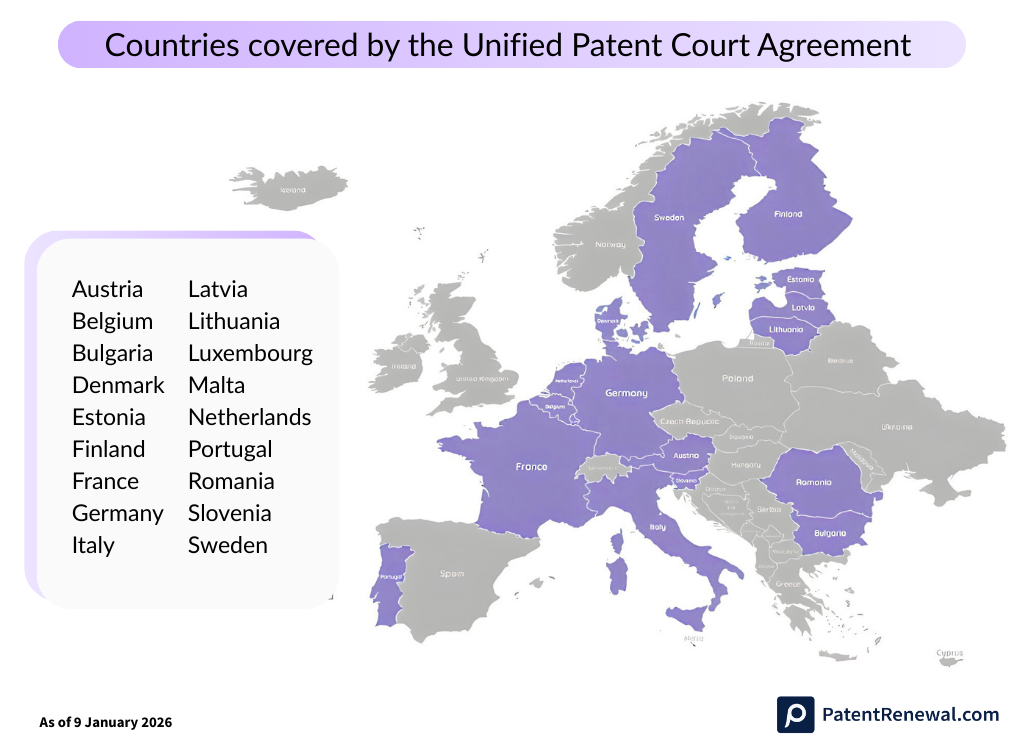
Two practical consequences follow from this rule:
- The coverage is fixed for that patent’s lifetime
Once the EPO registers unitary effect, the country coverage stays locked in for that patent. If more countries join later, earlier unitary patents do not expand. This is why people sometimes talk about generations of unitary patents. The EPO Register gives you the cleanest check for one specific patent.
For example, if the EPO registered unitary effects before Romania joined (1 September 2024), the unitary patent covers 17 countries, not 18.
- The number of covered states can change over time
The EU set it up so more countries can join over time, up to 25 participating EU countries under the enhanced cooperation framework.
A few special cases include:
- Spain and Croatia: EU members, but they do not take part in the enhanced cooperation, so unitary protection does not cover them today.
- Ireland: signed the UPC Agreement, but it has not ratified it yet, so unitary patents do not cover it today.
- Hungary: signed the UPC Agreement, but it has not ratified it, and a constitutional court ruling triggered a constitutional hurdle, so it is not in the system today.
- UK: left the EU and dropped out of the unitary patent framework, so unitary patents do not cover it.
- Non-EU EPC states like Switzerland, Norway, and Turkey: they sit in the EPC, but unitary patents never cover them because the unitary patent is an EU system.
How do you request a unitary effect at the EPO?
The practical flow is simple:
- Get your European patent granted
- Unitary effect is a post-grant choice, not something you select at filing. (Source: EPO, Unitary Patent)
- File the request for unitary effect within the deadline
- File within one month after the mention of grant is published in the European Patent Bulletin.
- You don’t need to pay an extra filing fee for the unitary effect.
- The request itself has no official fee. You can file early after the decision to grant, but the EPO will only process it after publication.
- If you miss that deadline, unitary effect is no longer available for that granted patent.
- Provide the required translation during the transitional period
- During the transitional period (6 years, maximum extension up to 12 years) file one extra full translation when you request unitary effect. If the language of proceedings is English, translate into any official EU language.
- If it is French or German, translate into English. The translation is for information only.
- SMEs, natural persons, non-profit organisations, universities and public research organizations can also claim a EUR 500 compensation to help cover translation costs.
- Wait for the EPO to register unitary effect
- The unitary patent takes effect on the date the mention of grant is published. The EPO registers unitary effects after checking the formalities.
If you need coverage beyond the Unitary Patent territory, you can request unitary effect and also validate the same European patent in the EPC states that the Unitary Patent does not cover. Treat it as a combined post grant plan, not an either or choice.
What's the renewal cost of a unitary patent?
As there is no extra filing fee for the unitary effect, the main cost question is about patent renewal fees and how they compare to the countries you would have validated anyway.
To keep a unitary patent in force, you pay one renewal fee every year directly to the EPO in euros, using the EPO’s payment methods and deadline rules.
The patent renewal fee falls due by the last day of the month that contains the anniversary of the filing date of the European patent application, and you can pay it up to three months early. If you miss the due date, you can still pay within a six-month late period, but you must also pay an additional fee.
| Renewal year | Fee (EUR) |
|---|---|
| 1 | - |
| 2 | 35 |
| 3 | 105 |
| 4 | 145 |
| 5 | 315 |
| 6 | 475 |
| 7 | 630 |
| 8 | 815 |
| 9 | 990 |
| 10 | 1,175 |
| 11 | 1,460 |
| 12 | 1,775 |
| 13 | 2,105 |
| 14 | 2,455 |
| 15 | 2,830 |
| 16 | 3,240 |
| 17 | 3,640 |
| 18 | 4,055 |
| 19 | 4,455 |
| 20 | 4,855 |
Total renewal fees for years 2 to 20: EUR 35,555. (Source: EPO FAQ on Unitary Patent renewal fees)
If you file a licence of right statement, you tell the EPO you are open to licensing the invention to anyone. From that point on, the EPO reduces your patent renewal fees by 15% for the fees that fall due after it receives the statement. (Source: EPO FAQ, Renewal fees)
When to choose a unitary patent?
First start by doing a quick reality check: list the countries you would validate in, add up the patent renewal fees for those countries (check our patent renewal fee articles for updated guides), and plan how many years you expect to keep the patent alive. If that total comes out higher than the unitary patent renewal path for the same years, the unitary patent usually makes more sense.
For example in a typical multi-country set like Germany, France, Italy, and the Netherlands, if you expect to keep the patent alive up to year 12, the estimated overall cost is EUR 16,527 for the classic route (validated in DE/FR/IT/NL) versus EUR 11,399 for a unitary patent, a 31% saving, mainly because the classic route sums up higher external admin and payment handling costs.
How does the unitary patent relate to the Unified Patent Court?
The unitary patent and the Unified Patent Court (UPC) go together in practice. When you choose a unitary patent, you do not just simplify post grant admin. You also choose the default court route that will handle enforcement and validity challenges for that right.
For classic European patents and applications, the UPC rules include a 7-year transitional period, with a possible extension of up to another 7 years. During that period, patent owners can file an opt-out to keep cases in national courts instead of the UPC. The opt-out only works if no UPC case has already started for that patent, and you can withdraw the opt-out later if you want to return to the UPC route.
Most people apply for unitary patents because they want the simplified coverage and patent renewals, but the biggest irreversible part of the choice is the court side, you cannot opt out a unitary patent, so you lock in the UPC route for infringement and revocation in the covered territory.
Unitary patent vs national patent validations
We’ve collected the main decision factors into one table which helps you choose between unitary patents or national validations. It is not legal advice, but it reflects how the system is structured in the official rules.
| Decision factor | Unitary patents are usually stronger when… | Classic validation is usually stronger when… |
|---|---|---|
| Target coverage | You want broad coverage across participating UPC states without managing many separate validations. | You only need a small set of specific countries, or your priority countries include non-participating states. |
| Coverage stability | You are fine with scope being fixed at registration date and you can live with “generations” of coverage. | You want flexibility to tailor the country list at grant, and to drop countries later without affecting the rest. |
| Renewal administration | You want one patent renewal fee, one currency, one deadline rule. | You are comfortable managing multiple renewal fees, or you deliberately keep only a few states alive long term. |
| Renewal fee economics | Your alternative would be validating and maintaining multiple states over time, so the UP fee level is competitive for your footprint. | You plan to keep protection in only one to three states for most of the patent’s life. |
| Enforcement strategy | You want a UPC-oriented enforcement path and accept that unitary patents cannot be opted out. | You want to preserve national court control via opt-out options where available. |
| Post-grant workload | You want fewer parallel steps after grant, fewer payment flows, and less fragmented admin. | You already have a mature country-by-country workflow and prefer to keep decisions granular. |
| Translation plan | You can handle the one full translation required during the transitional period, and you may qualify for compensation. | You already budget for validation translations and prefer to align translation scope with selected countries. |
A simple way to use the matrix is to circle your top two priorities. If your priorities are broad EU coverage and simplified patent renewals, unitary patents often map naturally. If your priorities are litigation control and selective long-term coverage, classic validations tend to be the safer default.
Mistakes to avoid with a unitary patent
You do not need a long list to get value here. These are the mistakes that actually create avoidable costs or irreversible outcomes.
Mistake 1: Assuming the unitary patent covers the EU
Coverage is limited to participating states where the UPCA is in force at registration, and it stays fixed for the patent’s lifetime. (Source: EPO Unitary Patent Guidelines, 1.5.1 Territorial scope)
Mistake 2: Treating it as a filing strategy instead of a post-grant decision
Unitary effect is requested after grant through the EPO process, and the time window is strict. (Source: EPO, Applying for a Unitary Patent)
Mistake 3: Missing the renewal logic
The UP renewal model is one fee to the EPO, one deadline rule, one late-payment window. This is often simpler, but it can be more expensive than a small country set if you only need limited coverage. (Source: EPO FAQ on Unitary Patent renewal fees)
Mistake 4: Ignoring the UPC angle
Unitary patents cannot be opted out of UPC jurisdiction. That should be a deliberate decision, not an accidental one
Mistake 5: Forgetting the transitional translation requirement
The translation is not a formality you can postpone. During the transitional period, it is part of the unitary request package. (Source: EPO, Translation arrangements and compensation scheme)
The unitary patent is most useful when it is treated like a portfolio architecture choice, not a default option. If you map your revenue footprint, your enforcement plan, and your internal admin capacity first, the choice often becomes clear.
If you want to check your optimal patent renewal costs for your portfolio, use our free cost calculator. If you want to review your patent renewal setup, you can sign up for a free consultation.
FAQ about the unitary patent
Is the unitary patent popular so far?
Yes, and the adoption numbers are now strong enough to be meaningful. The EPO reported that unitary protection was requested for 25.6% of all European patents granted in 2024, totalling over 28,000 requests, which was a 53% increase compared to 2023. (Source: EPO Patent Index 2024)
Are unitary patent renewals paid every year?
Yes. The unitary patent is maintained by annual patent renewal fees paid to the EPO.
When are unitary patent renewal fees due?
They must be paid by the end of the month containing the filing anniversary, with a six-month late-payment option if an additional fee is paid.
Can you opt out a unitary patent from the UPC?
No. A unitary patent cannot be opted out.
Does a unitary patent replace national validations?
Not fully. You may still need classic validations for countries outside the unitary patent coverage, depending on where you do business and where you want enforceable rights.
.png)
