
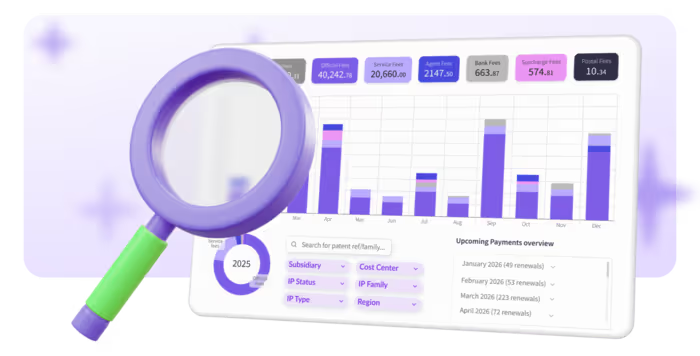

How to instantly calculate patent renewal fees worldwide

.png)
- Renewal fees are hard to calculate because each jurisdiction follows its own logic. Some base annuities on the filing date and others on grant, renewal years are not aligned, and EP validations and PCT national phase entries follow different rules.
- The free calculator takes the filing route, the filing date, the grant date for EP families, and the countries where the patent is maintained, then returns official fees per country in local currency with a total in EUR or USD.
- The tool came out of a LinkedIn poll and customer conversations. 73% chose a patent family calculator over a next-year calculator, an AI chatbot, or a patent family overview tool.
- Official fees are set by patent offices, published, and rise as the patent ages. Non-official costs such as service fees, local agent fees, currency markups, and transaction charges are why two identical portfolios can cost very different amounts.
- Late payment surcharges and grace period fees are excluded, because they depend on exact payment timing and each office's rules. A separate grace period checker covers those.
- No account is needed to use the calculator, and the data entered is stored on Europe based GDPR compliant servers.
If you’ve ever tried to calculate patent renewal fees, you know it should be straightforward, but in practice, it rarely is. That’s exactly why we built our new free calculator. In this article, we’ll show how it works and what actually drives your next patent renewal cost across jurisdictions.
Over the past few years, we’ve focused on building a more complete approach to patent renewals, bringing cost visibility, automation, and transparency into one place. Through this, we started to notice a consistent gap. Many IP professionals were not struggling with theory or definitions. They were trying to answer a much more practical question: what is the next patent renewal cost across my actual portfolio?
To understand this need better, we didn’t rely on assumptions. We asked directly and did a research. We ran a LinkedIn poll and spoke with our customers who manage patent renewal decisions daily. We explored different directions, including a next-year calculator, an AI chatbot, and a patent family overview tool.
The result was clear. 73% chose the patent family calculator. The reasoning came up again and again in conversations:
“Most teams don’t have access to reliable patent renewal cost data, which makes budgeting difficult. What’s really needed is a simple way to input minimal information and get a clear, structured overview of the entire patent family, including upcoming annuities across jurisdictions. Existing tools tend to be too rigid, while a flexible overview that supports forecasting and portfolio decisions would be far more useful in practice.”
Why calculating patent renewal fees is still harder than it should be
On paper, calculating a patent renewal fee should be simple. Official fees are published, timelines are defined, and rules are available. But once you work across multiple jurisdictions, things quickly become less straightforward.
Each country follows its own logic. Some calculate patent annuity fees based on filing date, others on grant. Patent renewal years are not always aligned, and annuity payment timing can vary. The complexity increases further when working with different routes, such as EP validations compared to PCT national phase entries, where renewal structures and timelines follow different rules. When you combine this with multiple currencies even a simple question becomes difficult to answer.
Most IP teams end up building their own workarounds. Spreadsheets, manual checks, and fragmented data sources become the default. Even then, getting a clear view of the next patent renewal cost across a full patent family takes time. That gap between available data and usable insight is what we focused on.
How to use the patent renewal calculator?
The feedback we received pointed in a clear direction. By entering a few key details, you can immediately see how your next patent renewal cost comes together across countries, without manual calculations or fragmented data.
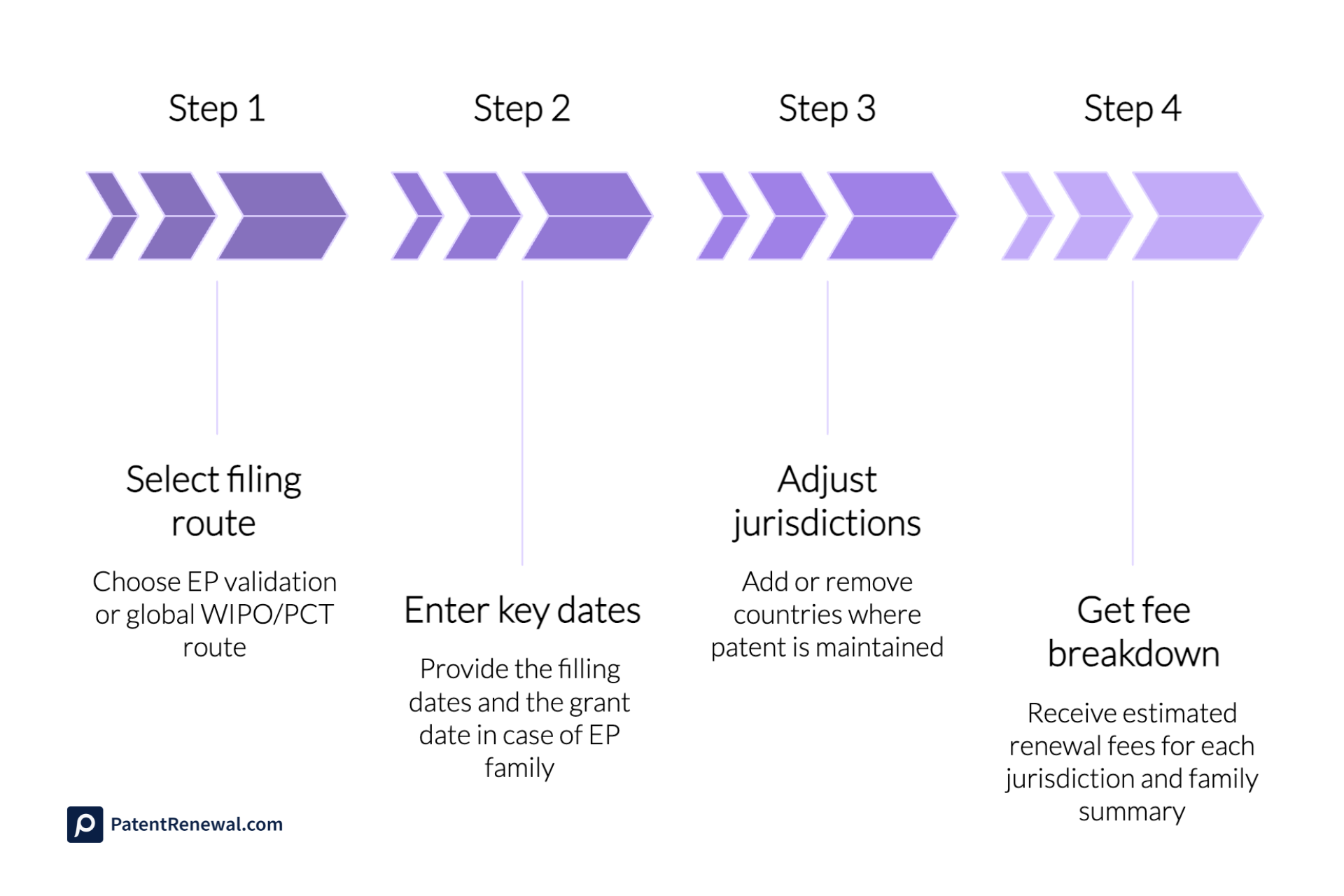
The process is simple, and you instantly see your patent family renewal fee calculations:
- Enter your patent details: Select your patent filing route (EP or WIPO/PCT).
- Select filing date: And the grant date in case of an EP family.
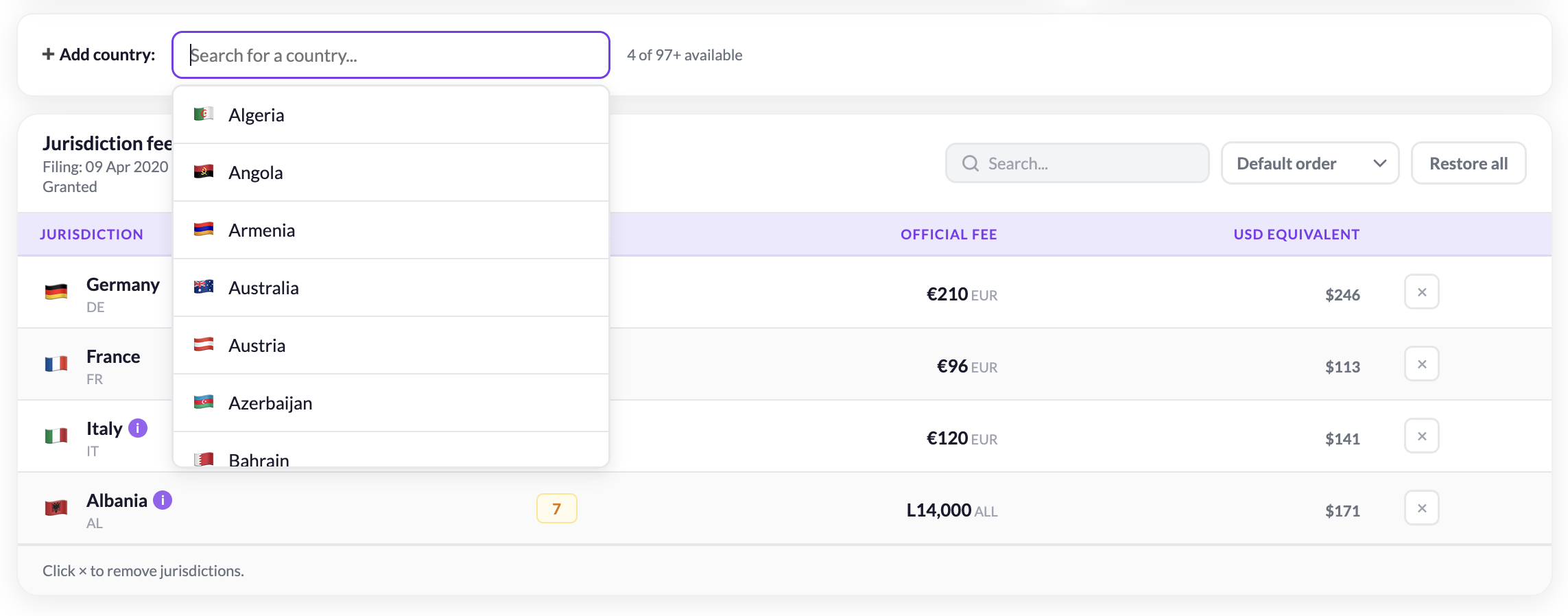
- Select your jurisdictions: Build your patent family by adding the countries where your patent is active. For EP routes, this includes all EP member states, validation states, and extension states. Adjust it freely depending on your portfolio.
- See your next patent renewal cost: Get an instant overview of official patent renewal fees per country, in local currency, with a total converted into EUR or USD.
- +Request a full quote: Click the “renew patents” button in the tool and enter your contact details. You will receive a detailed patent renewal cost breakdown, including both official patent renewal fees and service fees for a transparent comparison.
-> You can try it here.
What can I get from the patent renewal fee calculator?
The patent renewal family calculator supports how patent renewal decisions are actually made, across jurisdictions, timelines, and budgets.
- Clear view of your next patent renewal cost: Instantly understand what is due next across your patent family, without checking each country separately.

- Consistent cost comparison in one currency: Evaluate your total official patent renewal cost without switching between currencies or estimating conversions.
- Full visibility across jurisdictions: See how patent renewal fees are distributed across countries and how each jurisdiction contributes to the total cost.
- Stronger budgeting and forecasting: Use a clear, structured estimate of upcoming patent annuity fees to support internal planning and financial alignment.
- Clearer ROI across your patent family: See where your patent renewal cost is concentrated and assess whether each jurisdiction still justifies the investment. This supports more informed decisions on where to maintain, reduce, or optimize protection.
- Reliable baseline for cost transparency: Start with official patent renewal fees as a clear foundation before evaluating the full cost structure across EP, PCT, and national systems.
From calculation to full cost visibility
Understanding official patent renewal fees is the starting point. The next step is seeing the full patent renewal cost, including non-official components. Once you have your overview, you can request a full renewal quote directly from the tool.
The full patent renewal quote provides:
- a complete breakdown of all cost components
- visibility into non-official fees (service, FX, transaction, local agent (if any)
- a clear comparison of potential savings
What actually makes up a patent renewal cost
There is an important distinction between official fees and non-official fees when it comes to patent renewal cost categories. Official patent renewal fees are the fees set by national or regional patent offices. These are fixed and publicly available, and they typically increase over time as the patent ages. These are the baseline patent annuity fees that every patent holder must pay to keep protection active.
On top of that, there are non-official costs, which depend on how patent renewals are managed.
These can include:
- service fees charged by the IP renewal provider
- local agent fees in certain jurisdictions where they are legally required
- currency exchange rates or markups
- transaction or administrative costs
Two portfolios with the same patents can have very different total renewal costs, simply because of how these non-official fees are structured.
That’s why, when looking at patent renewal fees, it’s important to first understand the official baseline, and then see how the full cost is built on top of it. This total can vary significantly from provider to provider, often driven by high FX markups or the use of local agents for convenience.
Try the patent renewal fee calculator
If you want to understand your next official patent renewal fee across your patent family, you can try the free tool here.
To take things further, get a full IP cost audit to uncover hidden charges and benchmark your spending against optimal market rates. Submit your IP data/recent IP renewal invoice and understand all related costs of your IP renewals across all jurisdictions.
FAQ: Patent Renewal Official Fee Calculator
What information do I need to use the calculator?
To calculate upcoming official renewal fees, you only need a few key inputs:
- The filing date of the patent
- The grant date
- The patent family route (EP validation or WIPO / PCT route)
- The jurisdictions where the patent family is maintained
Based on these inputs, the calculator determines the upcoming annuity year and estimates the official renewal fees.
How accurate are the patent renewal fee estimates?
The calculator uses publicly available official patent office fee schedules and applies the relevant annuity rules to estimate the upcoming renewal cycle.
The results provide a reliable cost estimate for planning purposes. The exact renewal cost may vary depending on factors such as:
- the exact payment date
- currency conversion rates, recipient bank fees, postal fees
- grace periods or late payment surcharges
- service fees charged by other renewal providers or local agents
Can I calculate renewal costs for multiple countries in a patent family?
Yes. The calculator allows you to add or remove jurisdictions so the calculation reflects the actual countries where your patent family is maintained. This provides an overview of the total upcoming patent renewal cost across multiple jurisdictions in a single calculation.
Does the calculator include late payment surcharges or grace period fees?
No. The calculator focuses on standard renewal deadlines and official annuity fees. Late payment surcharges and grace period fees are not included because they depend on the exact payment timing and the rules applied by each patent office. These additional costs may apply if a renewal is paid after the standard deadline.
For checking patent grace period & surcharges use our Patent Grace Period Checker tool to see if you are still in the grace period, or exactly how much the surcharge fee is in your jurisdiction.
Do I need to become a PatentRenewal.com customer to use the calculator?
No. The patent family renewal fee calculator can be used independently as a planning tool. Entering your patent data does not create an account and does not make you a customer of PatentRenewal.com. The calculator simply estimates upcoming renewal fees and provides a cost overview for the next annuity cycle.
Is the information I enter into the calculator stored or shared?
The calculator only uses the information you provide to estimate upcoming patent renewal fees. All your IP data is stored on Europe based GDPR compliant Heroku servers with a high level of network security. If required, we can also provide a Service Level Agreement outlining how information is handled and protected.
.png)
