FREE TOOL LAUNCHED! CALCULATE RENEWAL FEES FOR YOUR PATENT FAMILY INSTANTLY
Try now
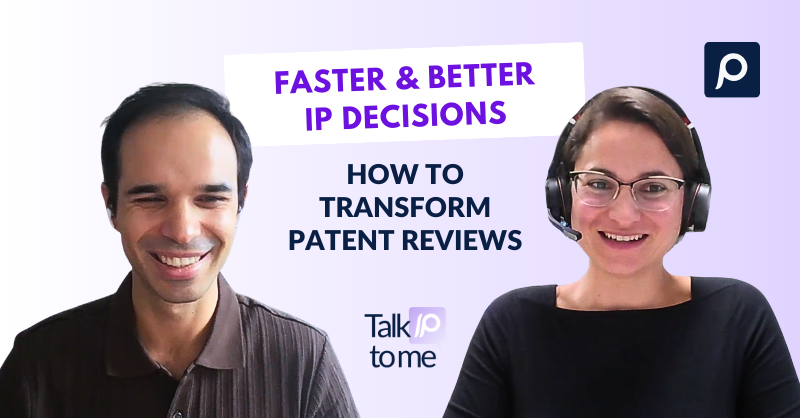
In this episode of Talk IP to me our host David Breitenbach talks with Katalin Sólyom, who led IP management spread across the Nagel Group. Katalin brings a research mindset into IP and works closely with R&D, management, and business teams in a highly technical environment.
They discuss why IP is often misunderstood, how communication shapes better decisions, and what helps IP become part of everyday business thinking.
Katalin did not start her career in IP. She spent nearly a decade in chemical engineering and biotech research before moving into intellectual property.
What motivated the shift was curiosity. About how technology connects to business decisions and legal frameworks, and how IP can influence what happens beyond research.
“It was mainly my curiosity into the intersection of technology, business, and legal aspects, which I can find in the world of IP.”
At the time of our conversation, she led IP management, spread across three companies (Gehring Technologies, Nagel Technologies, Elgan Diamantwerkzeuge). The three companies are part of the Nagel Group, which specializes in precision machining and e-mobility solutions, along with its sister companies, all focused on high-precision industrial manufacturing.
Building on her research background, Katalin explained that IP decisions in practice are rarely based on hard facts alone. Numbers matter, but they often come as percentages and assumptions. Relying only on data can create blind spots.
“I would also add the question is there something else that we are not taking into account.”
IP decisions also need to be revisited over time. IP renewal deadlines, market changes, and new technologies force reassessment.
“We thought we had that information and we made those assumptions. And now it’s another time in business, in technology.”
In fast-changing industries like e-mobility, flexibility is essential. Unlike classical technologies, e-mobility has not yet reached product consolidation. Katalin explained that while classical technologies saw small, incremental changes to specific features, modern electric motors change much faster.
This forces the company to ask if their existing machine concepts can even build these new products, or if they need a completely different concept. To navigate this, Katalin suggests assessing a patent's value with three practical lenses:
When Katalin joined, she inherited an IP landscape that had been managed by the same expert for over 30 years. This caused a cultural and knowledge gap, since decisions were being made based on information that often had nothing to do with legal requirements, but everything to do with internal history.
Adapting decisions over time only works if people across the business are able to engage with IP in the first place. A clear example from the episode shows how communication directly affects efficiency. At first, Katalin shared lists of new patents with R&D, but this process was slow and limited feedback.
“So in an hour we could check three patents and we had like twenty on the list.”
The breakthrough came when she stopped asking for feedback and started teaching colleagues how she reads patents and what kind of feedback helps future decisions. She also aligned expectations around terminology and structure, so patents did not need to be reread every time.
“One year after this transformation, we are able to check like twenty patents in an hour.”
Katalin knew the strategy was working when she began hearing her own sentences and IP logic coming back to her from colleagues in other departments. It was no longer just a legal requirement, but a tool they were actively using in their daily business.
One of the central themes of the episode is why IP often feels difficult inside organizations. According to Katalin, the challenge is not that people dislike IP. It is that IP sits between technology, business, and legal. Many decision makers do not feel like experts in all three, and that makes decisions uncomfortable.
“It’s a field where maybe you can feel like I don’t know enough from all the sections to be an expert. And to make good decisions, no one likes this kind of feeling.”
To move IP from a legal requirement to a trusted daily tool, Katalin uses a tailored Information approach:
Katalin knows this strategy is working when she sees IP logic being used naturally in daily work. Whether it is a Sales person sending a video of a competitor’s new tech from a trade show or an engineer providing a short, contextual summary of a patent's impact, IP becomes a shared language for the whole company.
“I will help you. I will give you the information you need. We will find the point where you are in your information load.”
Throughout the conversation, she comes back to the same idea: progress is measured by shared understanding rather than just formal meetings. That mindset is what allows IP to move from a legal requirement to something teams actually use and trust in their daily work, she advised:
“Listen and understand.”
For the full conversation with Katalin Sólyom, listen on Spotify, Apple Podcast, or YouTube. Follow Talk IP to me for more real stories and practical insights from the IP industry.
Interested in a free IP renewal consultation? Benchmark your current IP renewal setup and costs against market standards.

.png)