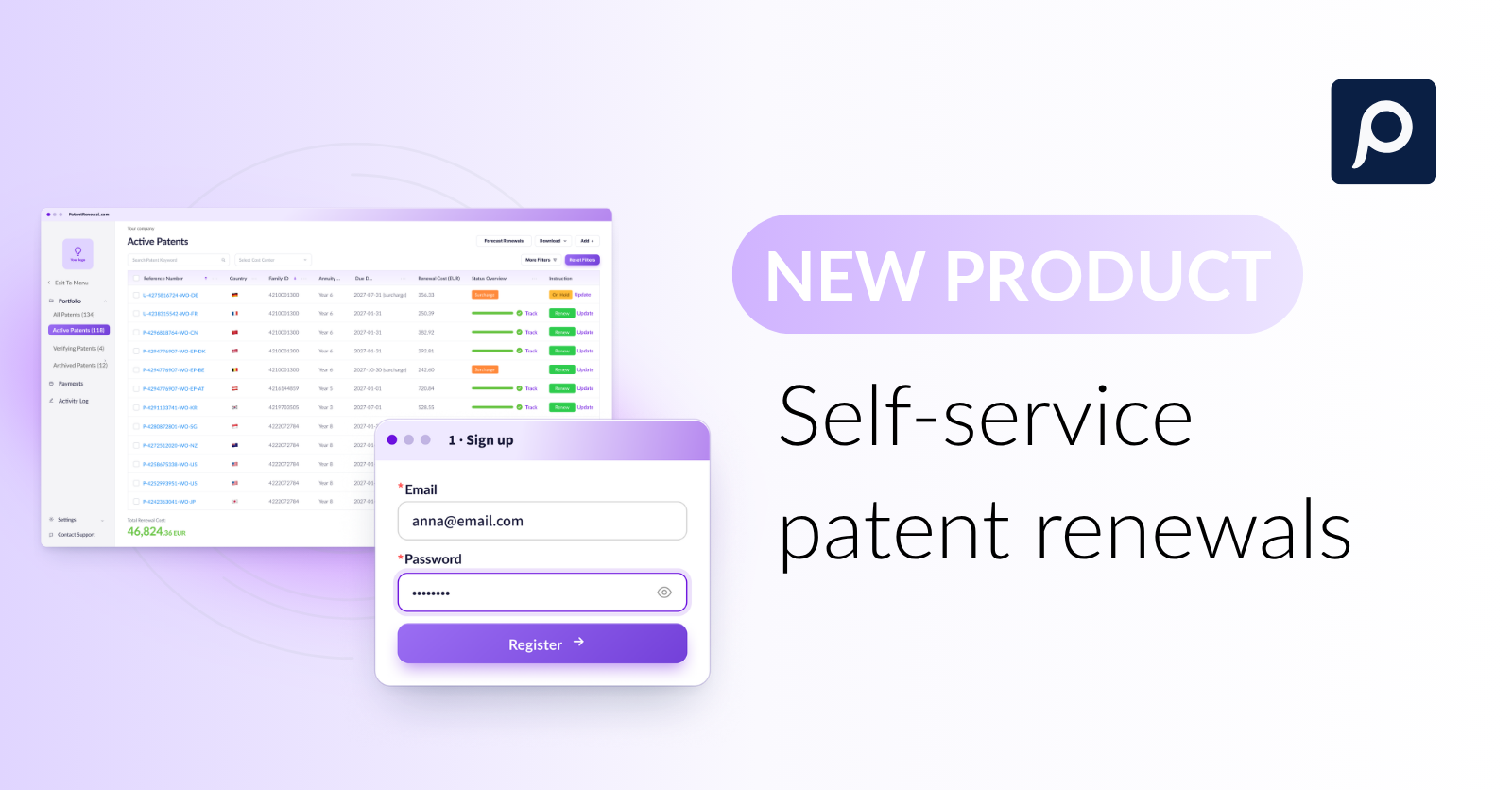
FREE TOOL LAUNCHED! CALCULATE RENEWAL FEES FOR YOUR PATENT FAMILY INSTANTLY
Try now
.avif)
For many IP professionals, the honest answer is: yes, usually.
Patent renewal is not always a task that requires a long provider handover, several introductory calls, or a fully managed service model from day one. If the patent data is clear, the deadline is not urgent, the jurisdiction is familiar, and the renewal route is straightforward, it is usually possible to handle the process directly. In most jurisdictions there is also no legal barrier: a renewal fee can generally be paid by anyone, not only the proprietor or a qualified representative.
But that does not mean patent renewal is simply a payment task.
The real work is knowing what needs to be checked before any payment is made. An IP renewal mistake usually comes from using the wrong deadline, selecting the wrong renewal year, missing a surcharge rule, misunderstanding the payment window, or relying on data that has not been validated recently.
Renewing yourself works when the portfolio is small, the jurisdiction is familiar, and the data has been checked against the register recently. It stops working when any one of those is missing. The question is rarely whether you can. It is whether the conditions make it a reasonable use of your time.
.png)
Most portfolios sit on both sides of this table at once. That is the practical problem: the same portfolio can contain renewals that are trivial to handle directly and renewals that are not, and telling them apart is itself the work.
Confirm the patent is active, correctly identified, and actually due for renewal before you look at payment at all. The first question is not "where do I pay?"
That means checking the patent number, jurisdiction, owner, application or grant status, next renewal year, and relevant date basis. Depending on the jurisdiction, renewal calculations may depend on the filing date, grant date, annuity year, national phase entry, or local office practice.
This is where a surprisingly high number of patent renewal issues begin. A patent can appear simple on a spreadsheet but become more complex once the record is checked against official data. The patent may have changed ownership, entered a different status, passed into a late payment window, or become subject to a fee rule that is not visible from the patent number alone.
Ownership matters more than it first appears. If an assignment has not been recorded, the payer details, entity status, or authorization may no longer match the register. Public registers, the EPO Register, USPTO Patent Center, Espacenet, and national equivalents are where that gets confirmed.
Patent renewal rules are not globally standardized, and the differences are structural rather than cosmetic. They differ in when the fee falls due, how the renewal year is counted, whether a grace period exists, how much the fee is, and whether a local representative is required to pay it.
In the United States, maintenance fees on utility patents fall due at 3.5, 7.5 and 11.5 years from grant. The payment window opens six months before each due date, and a six-month grace period follows it with a surcharge. Fees run from roughly $2,150 to $8,280 per payment for large entities, and entity status (large, small, or micro) changes the amount payable, with small and micro entities paying reduced rates. Claiming the wrong status creates a fee deficiency rather than a saving. Design patents carry no maintenance fees at all. Current amounts are published in the USPTO fee schedule (we also have a breakdown on our US patent renewal fees page).
At the EPO, renewal fees on a pending European patent application become due from the third year, on the last day of the month containing the anniversary of the filing date. They can be paid in advance, and a six-month additional period is available with a 50% surcharge. Fees start at €725 for the third year and rise to roughly €1865 by year 10 (see our EPO renewal fees page for the full schedule).
Once the EPO grants a conventional European patent, it turns into a bundle of national patent rights across the countries where the owner validates it. From that point, the owner must handle renewals country by country. Each jurisdiction can apply different fees, payment deadlines, grace periods, currencies, and procedural requirements. That shift from one European application to several national rights often causes confusion for teams that have mainly dealt with the application stage.
A Unitary Patent is the exception in the other direction: a single renewal fee paid to the EPO covers all participating states. It is the clearest case where handling renewal directly is straightforward.
Elsewhere, the fee may depend on the year of protection, the number of claims, the patent type, local representation requirements, or whether the payment falls into a surcharge period.
An IP professional looking at global renewals needs to know:
Take the renewal year from the official register, on that jurisdiction's date basis, then price it from the current official fee schedule for the year the payment actually falls in. The annuity year is one of the most important details in the process, but it is not calculated or presented the same way across jurisdictions. Some offices count renewal years from the filing date, while others base them on the grant date or apply jurisdiction-specific rules that affect how the next payment year is identified.
For IP teams, this is where internal records need to match external reality. If an internal spreadsheet shows one renewal year but the official register suggests another, the payment should not move forward until the difference has been resolved.
Once the correct renewal year has been confirmed, the corresponding fee still needs to be identified. In some jurisdictions the official fee is easy to verify from a published schedule. In others, the amount depends on entity status, the number of claims, the patent type, or whether the payment falls within a surcharge period.
The stakes are higher than a single payment suggests. According to WIPO, renewal fees can account for as much as 75% of a patent's total lifetime cost so an error repeated across a portfolio compounds quickly.
Two things make the cost harder to pin down than it looks. Official fee schedules are revised sometimes annually, so a figure carried over from last year's budget may already be wrong. And where a local representative is required, their fee sits on top of the official one and is not published anywhere. Always price the renewal from the current official schedule for the year the payment falls in, not from your own records.
Some patent offices accept direct online payments, while others require a bank transfer, a deposit account, a local representative, or a specific payment reference. The available route may also depend on the payer, the currency, and local filing requirements.
Before submitting the payment, confirm the accepted method, account details, reference format, and any authorization rules that apply. Even when the amount is correct, using the wrong payment channel or reference can delay allocation and put the renewal at risk. Bank transfers create timing risk. Currency conversion creates reconciliation issues. Internal approvals delay execution.
Where a local representative is required, the process becomes more complex. The patent owner first needs to find and instruct a reliable local agent, confirm their fees and payment details, transfer the funds to them, and make sure they complete the payment correctly and on time. This adds another party, another payment step, and another point where delays or misunderstandings can occur. It is also possible to renew without a patent attorney in many cases.
For one patent, this can often be managed manually. For a portfolio, it becomes a workflow issue. Someone needs to know who approved the patent renewal, when the instruction was given, which amount was paid, whether the office received it, and where the confirmation is stored.
It depends which of three stages you are in: inside the grace period, where the fee is still payable with a surcharge; lapsed, where restoration may be possible by petition; or beyond the restoration window, where there is no route back. Renewing before the due date is very different from renewing during a grace period. A patent that is one day late, three months late, or beyond the final recoverable deadline may require completely different handling.
Broadly, there are three stages, and they are not equally recoverable.
Late but within the grace period. Many offices allow payment after the due date with a surcharge. In the United States, that window is six months after the maintenance fee due date. At the EPO, it is six months with a 50% additional fee. Some jurisdictions apply a fixed surcharge, some calculate it as a percentage, and some vary it by renewal year or patent status. Some provide no practical grace period at all. Our grace period and surcharge checker will tell you where a specific patent stands.
Lapsed, but potentially restorable. Once the grace period closes, the patent lapses. Some jurisdictions allow restoration or reinstatement on request, usually within a limited period and usually only where the failure to pay meets a legal standard, in the US, that the delay was unintentional. Restoration is a filing, not a payment: it requires a petition, a fee, and in some cases evidence. It is also discretionary, and third-party rights may have accrued in the meantime.
Beyond recovery. After the restoration window closes, the right is gone. There is no route back. This is where doing it yourself becomes genuinely risky. If the patent is comfortably ahead of the deadline, the process may be straightforward. If the patent is already late, the question changes from "how much is the renewal fee?" to is this patent still recoverable, and what exactly must be paid or filed to keep it alive? That second question is a different kind of problem, and it is usually not one to work out for the first time under time pressure.
Not always and the later the annuity, the more the question is worth asking, because around 71% of a patent's total maintenance spend falls after year 10. In some jurisdictions the skew is still sharper: 88% in Germany, 80% in China, and 83% in Korea. Worth pausing on, because the checks above assume the answer is yes.
The most consequential decision in the renewal cycle is not how to pay. It is whether a given patent still earns its place. Renewal fees escalate over the life of a right, so the later annuities are the expensive ones and they often fall on patents that were filed defensively, cover products no longer sold, or protect markets the business has exited.
The natural point at which to ask whether a patent still supports a product, licence, claim or competitive position is during the patent renewal cycle. Reviewing this before the deadline means that the payment becomes a portfolio decision. Reviewing it after the deadline has passed is a different matter entirely.
Keep the payment confirmation, the official receipt, the renewed-until date, and the updated next deadline enough to prove the payment was made on time if the office's own record is late or wrong. The renewal is not finished when the payment leaves the bank account. The payment should also be traceable afterwards, particularly if the office records the transaction late, applies it incorrectly, or a question arises about whether the deadline was met.
For a controlled renewal process, the final step should include:
Patent offices such as the USPTO and EPO provide payment statements, receipts, or payment confirmations that can be retained as evidence of the transaction. Store these documents in the relevant patent file or system so the renewal status can be verified and reported to finance, legal, management, inventors, external counsel, or business units.
At the point where tracking the renewals costs more time than making the payments. Doing renewals yourself is not difficult. That is precisely why it is easy to underestimate.
The failure mode is rarely competent. Nobody misses a deadline they are looking at. They miss the one they did not know existed, a national validation that was never added to the tracker, a fee schedule that changed, a renewal year counted from the wrong date, an agent who confirmed nothing.
Renewals become administratively complex as a portfolio grows across jurisdictions. A renewal service is worth it at the point where the data, the deadlines, the payment routes, and the proof stop fitting in one person's head. That is the gap PatentRenewal.com's online renewal solution was built to close, you can now try the IP renewal software and upload your portfolio without any onboarding, introductory call, or meeting first.
Sign up directly, upload your data, and review expert-validated renewal information before taking action. When you're ready, select a patent and instruct the renewal with one click, while PatentRenewal.com handles the payment and patent renewal process from there.
This gives a more direct way to start and greater visibility over each renewal, without having to manage every deadline, payment route, and confirmation manually.
Can anyone pay a patent renewal fee, or does it have to be the owner?
In most jurisdictions, anyone can pay. There is generally no requirement that the payer be the proprietor or a qualified representative; the office cares that the right amount reaches the right patent in the right window with the right reference. The exception is jurisdictions that require a local representative for procedural steps, so confirm the rule at the specific office before relying on this.
How much does it cost to renew a patent?
There is no single figure. Official fees vary by jurisdiction and by year of protection, and in some places also by entity status, claim count, or patent type. Fees escalate over a patent's life, so the later annuities are the expensive ones. Price every renewal from the current official schedule for the year the payment falls in the EPO's most recent revision took effect on 1 April 2026 and remember that a local agent's fee sits on top and is not published anywhere.
What happens if you miss a patent renewal deadline?
That depends which of three stages you are in: inside the grace period, lapsed but restorable, or beyond recovery. The first is a surcharge. The second is a discretionary filing. The third has no remedy. Establishing which stage applies is the first thing to do, before working out any amount.
Can a lapsed patent be restored?
Sometimes, but restoration is a filing, not a payment. It typically requires a petition, a fee, and in some cases evidence, and the office decides at its discretion. In the United States, delayed maintenance fee payment can be accepted where the delay was unintentional. Third-party rights may have accrued while the patent was lapsed, which can limit what a restored patent is actually worth.
Do you still pay renewal fees to the EPO after a European patent is granted?
No. Renewals go to the EPO only while the application is pending. On grant, the patent becomes a bundle of national rights and each validated state collects its own renewal, on its own date basis. A Unitary Patent is the one fee the EPO covers for all participating states.
When is it worth using a patent renewal service instead of paying yourself?
When the tracking becomes the work. A single patent in a familiar jurisdiction rarely justifies a service. A portfolio spread across jurisdictions with different date bases, agent requirements, and fee structures usually does not because any one renewal is hard, but because the system around them has to be maintained by someone.
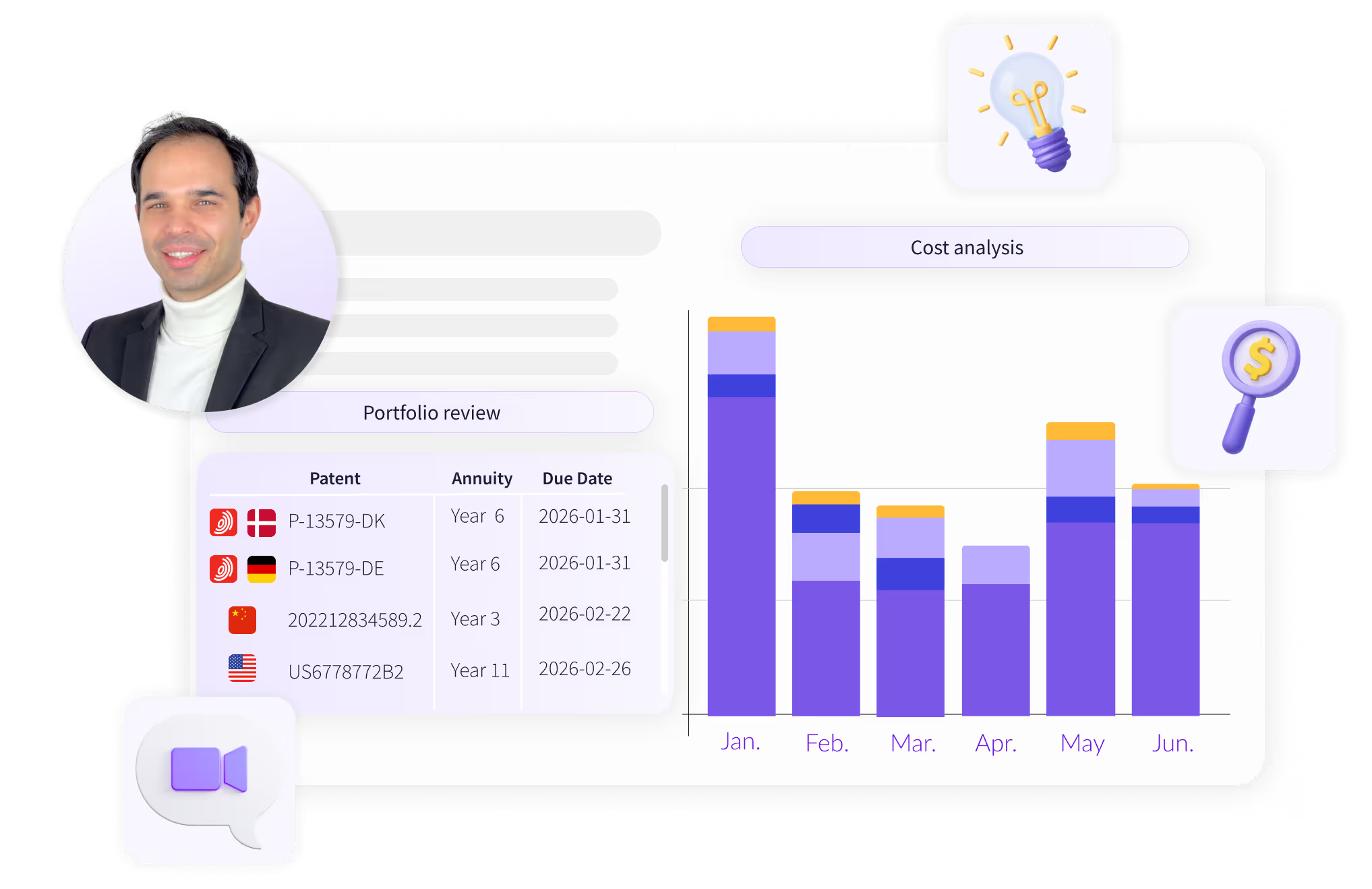
Interested in a free IP renewal consultation? Benchmark your current IP renewal setup and costs against market standards.

.png)