FREE TOOL LAUNCHED! CALCULATE RENEWAL FEES FOR YOUR PATENT FAMILY INSTANTLY
Try now
.avif)
.avif)
Packaging plays a crucial role in ensuring the safety and longevity of food products, shaping how we consume and distribute them. Among the most impactful innovations in this field is Tetra Pak, a Nordic invention that revolutionized food storage and distribution through its aseptic packaging technology.
Ruben Rausing, the founder of Tetra Pak, was a visionary Swedish entrepreneur. After studying at the Stockholm School of Economics and earning a Master's degree at Columbia University, he returned to Sweden with a deep understanding of large-scale industries and urbanization. These experiences shaped his ambition to modernize food packaging and distribution.
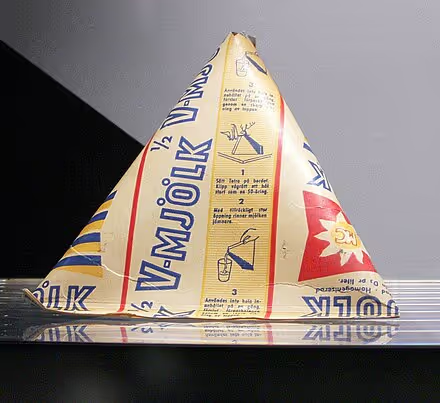
Rausing initially co-founded Åkerlund & Rausing, a company dedicated to packaging solutions. He soon focused on a pressing challenge in the dairy industry and how to package milk in a way that preserved its freshness, minimized waste, and improved transportation. In the 1940s, Rausing collaborated with inventor Erik Wallenberg, who devised the tetrahedron shape, which became the cornerstone of Tetra Pak’s design. Rausing provided the vision and resources to bring the innovation to market.
The breakthrough came when Rausing's wife, Elisabeth, suggested sealing milk through the packaging material to create an airtight container. This idea solved the problem of milk spoilage due to air exposure, setting the foundation for Tetra Pak’s aseptic packaging technology. The first working prototype of the tetrahedron-shaped package was built in 1946, and by 1952, the first Tetra Pak machine was installed in Lund’s dairy, marking a turning point in food packaging.
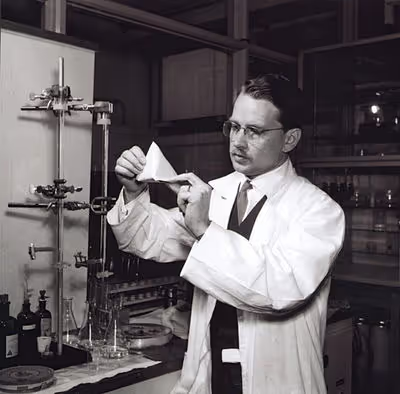
The invention of Tetra Pak was only the beginning. Rausing understood that protecting the innovation through patents was crucial for ensuring its success and global reach. In 1944, Tetra Pak filed its first patent for the tetrahedron-shaped package and the continuous filling process. This patent safeguarded the company’s pioneering aseptic technology and gave it a significant competitive advantage.
Over the years, Tetra Pak expanded its patent portfolio to include advancements in packaging materials, machinery, and designs. The company’s early patents covered not only the tetrahedron-shaped package but also innovations like the Tetra Brik in 1963 and the aseptic version in 1969. These patents secured Tetra Pak’s position as a leader in the industry and laid the groundwork for continuous innovation.
Tetra Pak’s patented aseptic packaging system transformed the food industry. By enabling long-term storage of perishable products without refrigeration, the technology addressed critical challenges in food logistics and safety. The packaging was lightweight and space-efficient, making it ideal for transportation and reducing environmental impact.
The invention and patents of Tetra Pak improved food safety and accessibility and also reshaped the global food supply chain. It made it possible to transport milk and other perishable liquids to remote areas, reducing waste and improving nutrition for millions worldwide.
Tetra Pak’s innovations expanded its applications beyond milk to include juices, soups, and other liquid food products, further revolutionizing food logistics and accessibility. By 2011, Tetra Pak had produced 173 billion cartons in a single year, showcasing its significant global impact.
Additionally, the company’s use of recyclable materials and renewable resources is aligned with growing global concerns about waste and resource efficiency. Their commitment to sustainability is reflected in new innovations like the Tetra Rex Plant-Based, launched in 2015, the world’s first fully renewable carton package made entirely from renewable materials.
The invention of Tetra Pak’s patented packaging system has significantly influenced the global food industry by enhancing food safety, reducing waste, and extending product shelf life.
Protecting your innovations is the key to creating lasting impact, just as Tetra Pak’s patents secured its revolutionary packaging technology.
Let PatentRenewal.com help you safeguard your ideas and optimize your IP portfolio, ensuring your innovations thrive for years to come. Discover how our solution can simplify the management of your patents with transparent pricing and expert support.
Interested in a free IP renewal consultation? Benchmark your current IP renewal setup and costs against market standards.



.png)