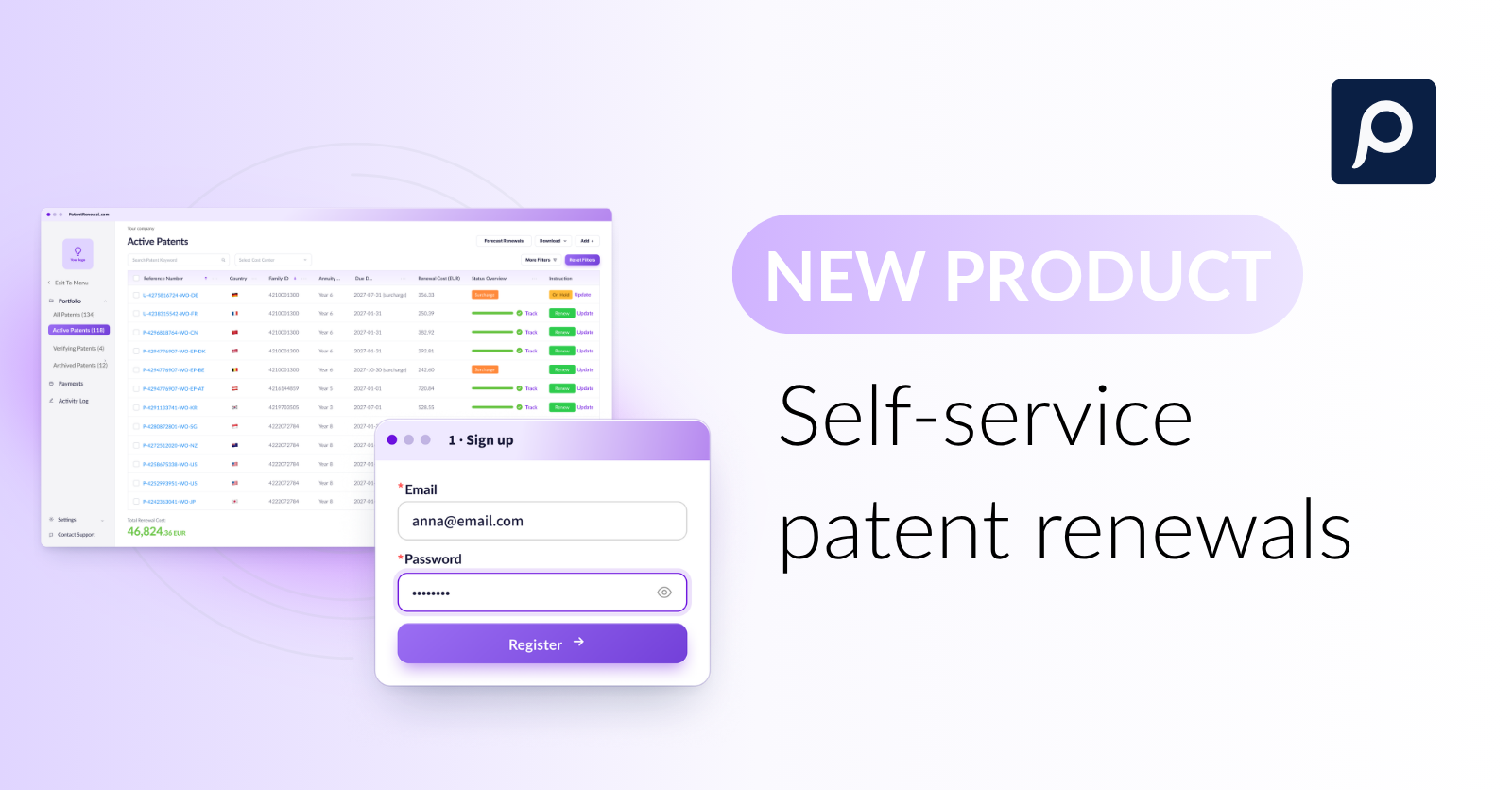
FREE TOOL LAUNCHED! CALCULATE RENEWAL FEES FOR YOUR PATENT FAMILY INSTANTLY
Try now

IP management software helps companies and law firms manage intellectual property records, deadlines, documents, workflows, costs and reporting in one system. Depending on the platform, it can also support invention disclosures, portfolio analysis, budgeting, IP renewal management, licensing and enforcement.
The term covers a broad range of software. A docketing system built around statutory deadlines solves a different problem from a portfolio management platform or a licensing system, even though all three may fall under IP management software.
This guide explains the main types of IP management software, the features they cover, what they cost, how implementation works, how to compare systems and where IP renewal management fits into the wider setup.
IP management software, also called an intellectual property management system or IPMS, helps organizations manage IP assets and the administrative processes connected to them.
An IPMS creates a central record for patents, trademarks, designs and other intellectual property rights. It connects those records with deadlines, documents, correspondence, responsibilities, costs and portfolio activity.
Functionality varies significantly between systems. Some focus heavily on patent and trademark docketing. Others cover a wider part of the IP lifecycle, including invention disclosures, budgeting, portfolio analysis, IP renewal management, licensing or enforcement.
G2 currently lists more than 170 products in its Intellectual Property Management category. Those products do not all solve the same problem, so companies should compare them according to the processes they need to manage rather than the category label alone.
An IP management system centralizes portfolio information and helps IP teams manage the workflows required to protect and maintain intellectual property rights.
Common IP management software features include:
| Function | What it covers |
|---|---|
| Portfolio management | Core records for patents, trademarks, designs and other IP rights, including ownership, jurisdictions, families, legal status and lifecycle information |
| Docketing and prosecution | Statutory deadlines, office actions, prosecution events, filing milestones and reminders |
| IP renewal management | Renewal deadlines, renewal instructions, official fee information, payment tracking, completed renewal status and supporting documentation |
| Document management | Applications, correspondence, certificates, office documents and other files linked to individual IP rights |
| Workflow and collaboration | Task assignment, approvals, instructions, responsibilities and coordination between internal teams and external counsel |
| Financial management | Historical IP spend, invoices, budgets, IP renewal costs, future cost forecasts and financial reporting |
| Reporting and analytics | Portfolio status, geographic coverage, lifecycle trends, ownership, upcoming activity and management dashboards |
| Integrations and data exchange | Connections with patent offices, IP renewal providers, IP data sources, finance systems and other business software through integrations or APIs |
| Access, governance and audit | User roles, permissions, activity history, change tracking and audit trails |
| Invention and innovation management | Invention disclosures, inventor information, internal review processes and decisions on whether to pursue protection |
| Licensing and commercialization | License agreements, royalty calculations, contractual obligations and revenue associated with IP assets |
| Search, intelligence and enforcement | Patent searching, competitive intelligence, portfolio analytics, trademark monitoring and brand enforcement, depending on the system |
Our guide to IP management software features looks at the individual functions in more detail.
The five main types of IP management software are docketing software, IP portfolio management software, invention management software, licensing and royalty management software, and brand protection and enforcement software. Many platforms combine several of them.
IP docketing software calculates and tracks legal deadlines, prosecution events and actions associated with IP matters.
Typical functions include deadline calculation, reminders, correspondence management, matter records and workflow tracking.
Law firms and in-house IP departments commonly rely on docketing systems when they manage many active patent and trademark matters across different jurisdictions.
Our guide to IP docketing explains how the process works and which deadlines an IP docket typically tracks.
IP portfolio management software gives organizations a broader view of their IP assets, status, costs and lifecycle.
Typical functionality includes portfolio dashboards, jurisdictional views, patent family information, cost reporting, budgeting and management reporting.
These systems help in-house IP teams connect legal portfolio information with business and financial decisions, including decisions about which rights to maintain, expand or allow to lapse.
Invention management software manages the process between the creation of an invention and the decision to seek IP protection.
It can collect invention disclosures from employees or R&D teams, route them through internal evaluation and approval, store supporting information and transfer approved inventions into the filing process.
For organizations with high levels of R&D activity, these systems create a more structured connection between inventors, legal teams and patent filing decisions.
Licensing and royalty systems manage agreements and financial information connected with licensed intellectual property.
Functions can include contract terms, royalty calculations, reporting obligations, payment information and license performance.
A wider IPMS may include these capabilities, or an organization may use specialist licensing software alongside its main IP management system.
Brand protection software helps organizations identify, track and manage infringement and enforcement activity.
Depending on the platform, it can support online monitoring, evidence collection, case management and enforcement reporting.
Companies with large trademark portfolios or significant counterfeiting and online enforcement activity often need these functions most.
These categories are not mutually exclusive. Larger IP management platforms often combine several of them. The useful distinction lies in the processes and workflows each system manages.
IP management software brings portfolio records, deadlines, decisions and workflows into one structured system, reducing the amount of IP administration that depends on separate spreadsheets and manual processes.
The main practical benefits include:
The benefits still depend on the quality of the underlying data. Automating an inaccurate deadline or incomplete asset record does not make that information correct.
There is no standard price for IP management software. Costs depend on factors such as users, portfolio size, modules, integrations, support requirements and implementation complexity.
Public pricing also remains relatively uncommon. In our review of ten of the most-reviewed products in G2’s Intellectual Property Management category, only three published pricing without requiring a sales conversation.
Official renewal fees sit on top of the software cost and rise as patents age. A large-entity US patent, for example, owes USPTO maintenance fees of $2,150, $4,040 and $8,280 at 3.5, 7.5 and 11.5 years after grant.
The total cost normally includes more than the software license:
| Cost | What affects it | When it occurs |
|---|---|---|
| License or subscription | Users, portfolio size and modules | Monthly or annually |
| Implementation | Configuration and workflow complexity | During setup |
| Data migration | Record volume, formats and existing data quality | During setup |
| Integrations | Number and complexity of connected systems | Setup and ongoing |
| Training | Number of users and workflow complexity | Setup and ongoing |
| Support and additional modules | Service level and additional functionality | Ongoing |
Two systems with similar subscription prices can therefore have significantly different first-year costs.
Companies should request separate figures for the software license, implementation, data migration, integrations, training and ongoing support when comparing platforms.
They should also consider costs that sit outside the software license. For a patent portfolio, this can include official IP renewal fees and the cost of executing those payments.
Implementing an IP management system can take from several weeks to several months, depending on the portfolio, existing data, system complexity and required integrations.
A relatively simple deployment may involve configuration, data import and user training. A larger migration may also require data cleaning, custom workflows, API integrations, permissions, testing and a period when teams operate the old and new systems in parallel.
The quality of the existing portfolio data often affects the implementation as much as the technical setup itself.
Teams should therefore assess migration and data validation separately from the time required to configure the software.
An IPMS migration should validate important portfolio data rather than simply copy the existing database into a new system.
Incorrect dates, missing assets, outdated statuses and incomplete jurisdictional information can move into a new platform just as easily as correct data.
IP renewal data requires particular attention because an incorrect deadline can affect whether a right remains in force. Teams should check relevant dates, annuity years, jurisdictions and asset status against reliable source data before relying on the new system for future IP renewal actions.
PatentRenewal.com applies this approach when portfolios move into our IP renewal software. We rebuild IP renewal calculations against the relevant registers and jurisdictional rules rather than relying only on data supplied by the previous system or provider.
The same principle applies to a wider IPMS migration. Before transferring the portfolio, define:
For a wider review of portfolio records, costs and lifecycle information, see our guide to conducting a patent portfolio audit.
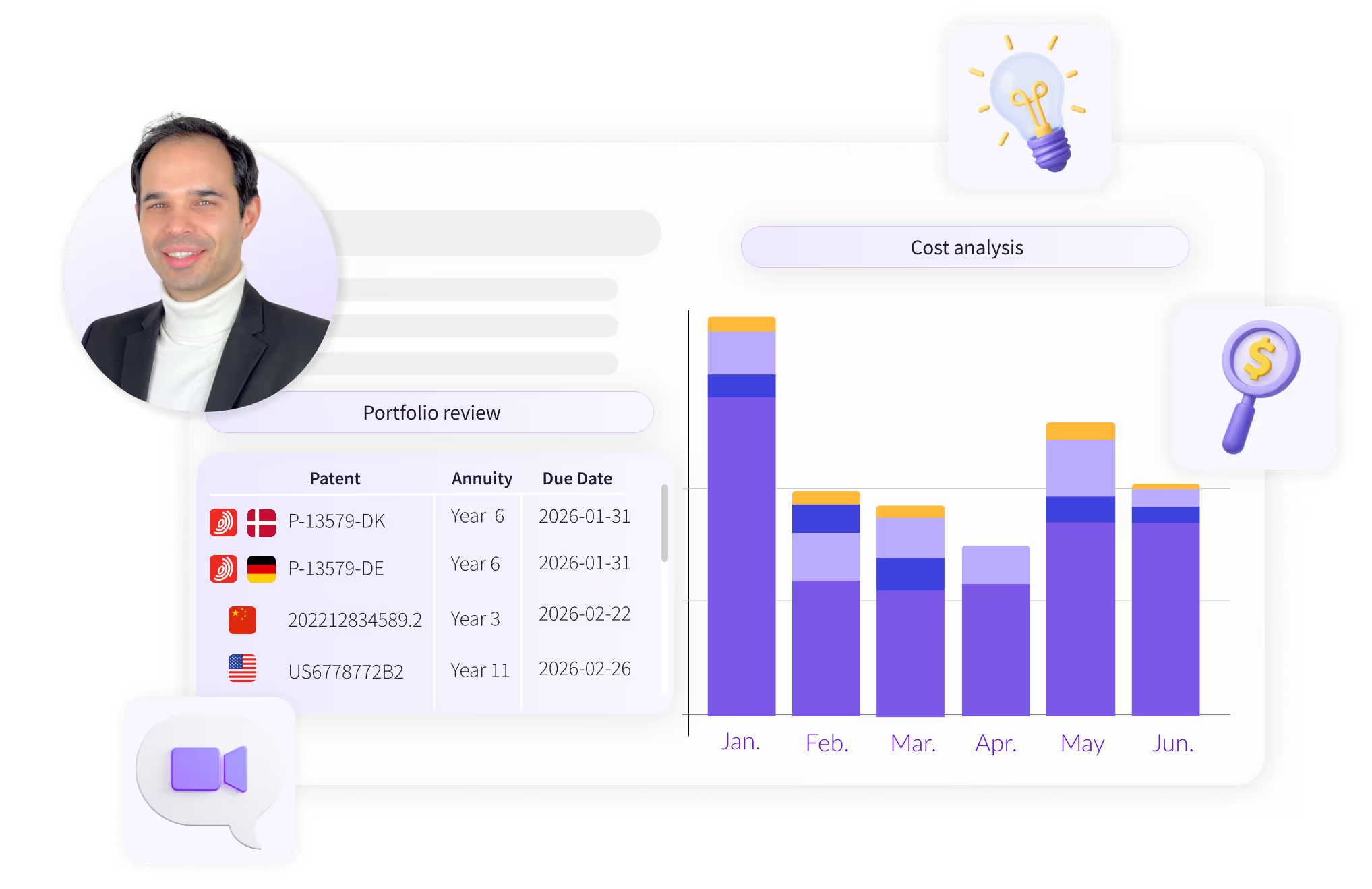
IP renewal management combines the portfolio information needed to make a renewal decision with the process required to execute that decision. An IPMS can manage the data and workflow itself or connect to a specialist IP renewal service for execution.
Within an IP management system, IP renewal management can include:
IP renewals are often handled through an integration between the IPMS and a specialist third-party renewal provider. The IP team gives renewal instructions directly in the IPMS, which are then sent to the provider. The provider handles the renewal and returns the completed status and documentation to the IPMS.
For example, PatentRenewal.com’s IP renewal platform can work alongside an organization’s existing IPMS rather than requiring the team to replace it.
Most IP renewal providers connect to an IPMS through a direct integration or an API. PatentRenewal.com, for example, integrates with Equinox, Patsnap, DIAMS, IPfolio, Ipendo, Memotech, PATTSY WAVE and AQX, and offers a renewal API for other systems. The IPMS stays the portfolio record; the provider validates the data, pays the official fee and sends the confirmation back.
When evaluating an IP renewal workflow, check:
The most effective setup keeps portfolio data, IP renewal instructions, payments and documentation connected without adding unnecessary manual work.
The right IP management software reliably supports the IP rights, jurisdictions, workflows and integrations that your organization actually uses.
A useful evaluation should cover:
| What to assess | What to check |
|---|---|
| Primary use case | Docketing, portfolio management, invention management, licensing, enforcement or a combination |
| IP rights and jurisdictions | Patents, trademarks, designs and countries the system supports |
| Deadline management | How the system calculates, updates and verifies deadlines |
| IP renewal management | How the system manages IP renewal deadlines, costs, instructions, payments and status |
| Data migration | What the vendor transfers, cleans and validates |
| Integrations and API | Connections with finance, document, ERP, IP renewal and other business systems |
| Reporting | Portfolio, cost and management views available to users |
| User roles and security | Permissions, audit trails, authentication and hosting |
| Support | Implementation, training and ongoing assistance |
| Data portability | Whether users can export complete portfolio data |
| Total cost | License, implementation, migration, integrations and ongoing services |
Do not compare systems purely by the number of features they advertise. Start with the processes your organization needs to manage, then assess how reliably each platform supports them.
Want to see what your renewals cost today compared with a specialist provider connected to your IPMS? Check your portfolio in the free IP renewal cost calculator. PatentRenewal.com guarantees a 30% saving on annual IP renewal costs.
IPMS stands for Intellectual Property Management System. The term usually refers to software that helps companies, law firms and IP professionals manage intellectual property records, deadlines, documents, workflows, costs and portfolio information.
In-house IP departments, patent and trademark law firms, patent attorneys, IP administrators and companies with intellectual property portfolios use IP management software.
The need for a dedicated system generally increases as the number of assets, jurisdictions, users, deadlines and external providers grows.
There is no single best IP management system for every organization. The right choice depends on portfolio size, IP rights, jurisdictions, workflows, integrations, reporting requirements, security needs and budget.
A specialist docketing system may suit one organization better than a broad enterprise IP platform, even when the enterprise platform offers more features.
A small and relatively simple IP portfolio can use spreadsheets and internal calendars, but manual management becomes harder to maintain as portfolio complexity increases.
Dedicated IP management software adds functions such as automated deadlines, workflow controls, permissions, reporting and audit trails that spreadsheets do not manage easily at scale.
Many IP management systems offer APIs or pre-built integrations with document management, finance, ERP and other business software.
Some also connect with specialist services such as IP renewal providers. Integration capabilities vary between systems, so organizations should check the specific tools and data flows they need before choosing an IPMS.
No. The IPMS holds the portfolio record, deadline and renewal instruction; the provider validates the data, pays the official fee and returns confirmation, usually through an integration or API.
Interested in a free IP renewal consultation? Benchmark your current IP renewal setup and costs against market standards.

.png)